Showing posts with label Musketeers. Show all posts

Monday, 30 November 2015

Feeling Two Tents? Not any more!

Hello again - it's been a while since the last post, so apologies for that! Up until a few days ago, I hit a wall in terms of painting.....real life, rubbish weather here in the UK, and general tiredness have take their toll in the evenings, so the brushes were being neglected. However, I finished off the last of my sheep earlier this week, which seems to have shaken off some of the lethargy, and I'm ready to get cracking again. No longer tense.....

Multi-period real estate from Renedra
Speaking of tents...... as mentioned in the previous post, I thought I'd write a small piece about the canvas shelters that are going to grace the tabletop in my ECW project. These are two of the lovely plastic tents from the Renedra Limited 'Ridge tents' set, which I picked up at the Partizan show last spring. I've still got two more to paint up at some point, as well as the camp beds that come with the set, but these beds are possibly 'out of period' for the 17th century. The camp fire is the other part of the set, which I've mounted on a circular base from Warbases.

Photo from Yahoo

Shelters in one form or another have featured in military service for thousands of years. Even if the rank and file still slept in the open, then at least their leaders or commanders would have had some form of tent or headquarters, befitting their status. During the wars of the 17th Century, shelters would have taken many forms, as shown in this woodcut of the 30 Years War.

Photo from Yahoo
There are many different types of shelter here - ranging from simple canvas sheet 'tents' in the foreground, to more ornate tents in the background, and shelters made from either canvas or wooden panels or 'sheets' on the left hand side of the picture. I like the idea of making some wooden shelters or canvas sheet tents at some point in the future, but for now I'll stick to the Renedra ones, and possibly get some dog tents from them as well.

The back of one of my tents, pitched near water. A soggy night ahead?

 
I put both of my tents on uneven shaped bases from Warbases, to protect them from damage and chips to the paintwork. They were undercoated in Wargames Foundry Canvas 8A shade, then painted over in the 'body' of the tents using Canvas 8B, leaving the 'sewn' lines where panels meet, and shading in the A shade. Then they were given a substantial highlight with Boneyard 9 B shade, followed by a final highlight of Boneyard 9B +9C mix, along the lines of the creases, ridges, and 'edges' etc. Having spent countless days and nights in these sorts of tents over 20 years  of re-enacting, I was especially keen to keep them to a more 'realistic' shade of canvas, instead of the more usual white that often graces the war-gaming table. Although these types of tents will be bleached by the sun, they often maintain at least a semblance of the pale cream canvas colour. The word "canvas" comes from the 13th century Anglo-French canevaz and the Old French canevas. Both of these words are derived from the Vulgar Latin cannapaceus for "made of hemp". Sadly the pictures haven't given a true representation of how creamy-white the models are, but I'm sure you'll get an impression.

Don't forget the tent pole!
The picture above shows off the entrance and interior of one of the open tents. I used a mix of diluted PVA glue and offcuts from a doormat to represent straw laid down on the floor of the tent. The tent pole is made of a cocktail stick, painted up. This only came about after I showed my significant other the (I thought) completed tent. "There's something missing," she exclaimed, "... a tent pole!" Thanks, love! So one was hastily added, and the subsequent slight gap was covered up by a small amount of foliage. On Living history camps, there's an oft seen sight of fresh herbs hanging in front of tents - either to dry for cooking, to prevent bad smells, or to ward away evil plague-bearing 'miasmas'! A simple touch, yet one that adds a touch (or should that be whiff) of authenticity!

Another aspect of camp life is the stowage and general clutter. I have painted up some stowage piles from Ainsty Castings trade goods range. I've now got a range of items, such as chests, barrels, fleece 'bales', and goods in wicker baskets, to go around my tents and houses. These not only give a sense of life to the table, but also offer cover for my troops.


Lastly for this post, a few words on some small bits of terrain I made earlier in the year, to show where there is 'rough' ground. These were put together using 3mm thick ply, cut and sanded to various shapes, then they were glued together with PVA. Modelling clay was used to smooth out the slopes, then I covered them in my usual PVA covered with sand 'mix'. Once dry, they were painted up, and various types of Woodland Scenics foliage added. I think they've turned out nicely, and again add another dimension to the table top.

Rough ground out of roughly trimmed off cuts...
Below are a few pictures of the completed assembly, and some scenes of camp life. I've still forgotten to take a group shot of my buildings, so that will definitely be in the next post! As will the start of the Scots......until next time!

Time for drill
A prisoner meets an untimely end...

... and Tam McLeod plans revenge!


Sunday, 1 November 2015

Completed NMA faction......and a little light reading!

Hi all! A week or so on from the last post, and it's time to show off the last of my NMA faction as it stands at the moment, for Donnybrook; before moving onto other parts of this project. I've also been going through a couple of books, which give a fuller picture of the Dunbar Campaign, and one of the characters involved - General John Lambert.

First though, a massive thanks to all those who continue to comment - either here or on other forums - and offer support and praise. It's all very humbling to get nice feedback about the figures and scenery I paint and create, and I'm glad that people are getting pleasure out of my efforts. I enjoy modelling and painting, as well as sharing my work, and if it continues to inspire people in the way that other bloggers have inspired me, then I'll keep going! Thank you!!!

First up then, the completed NMA Faction for Donnybrook. It's worth 4 points with a hero, so it works well for the basic version of the game.


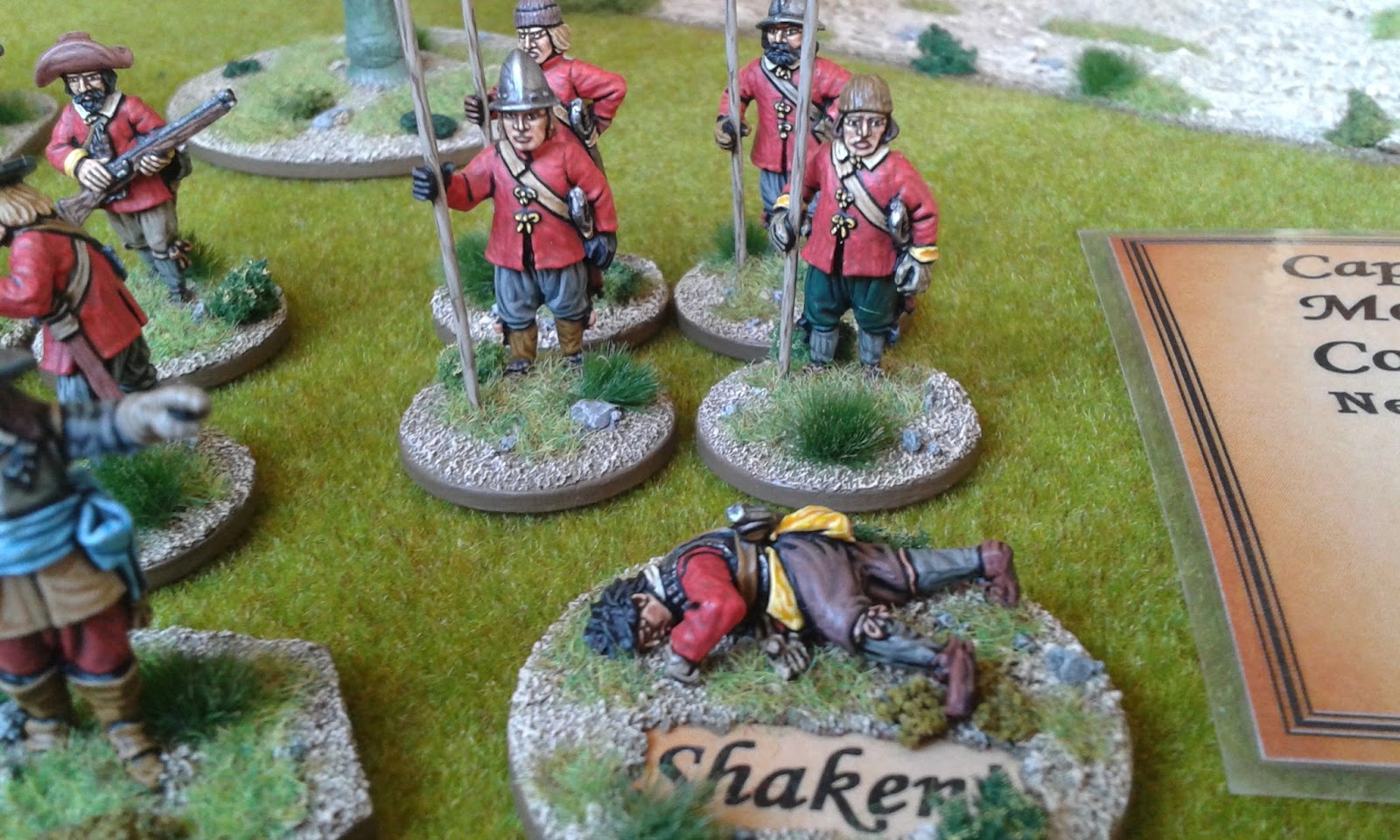
The completed faction, with Activation cards and shaken makers.

 
I managed to grab these pictures when there was better light, so I also took some close ups.
Major Robert Hawkins


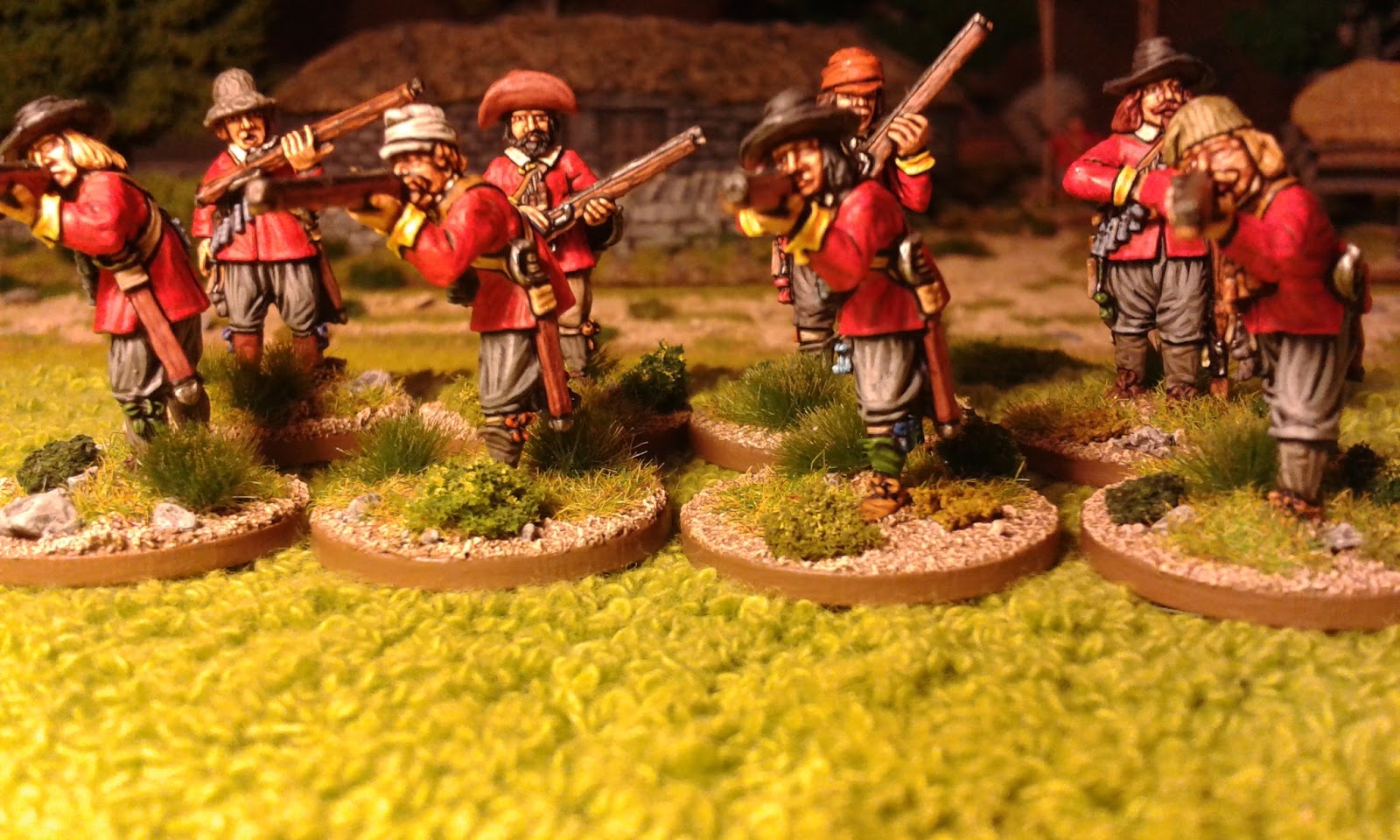
The Shot
Gentlemen of the Pike
 
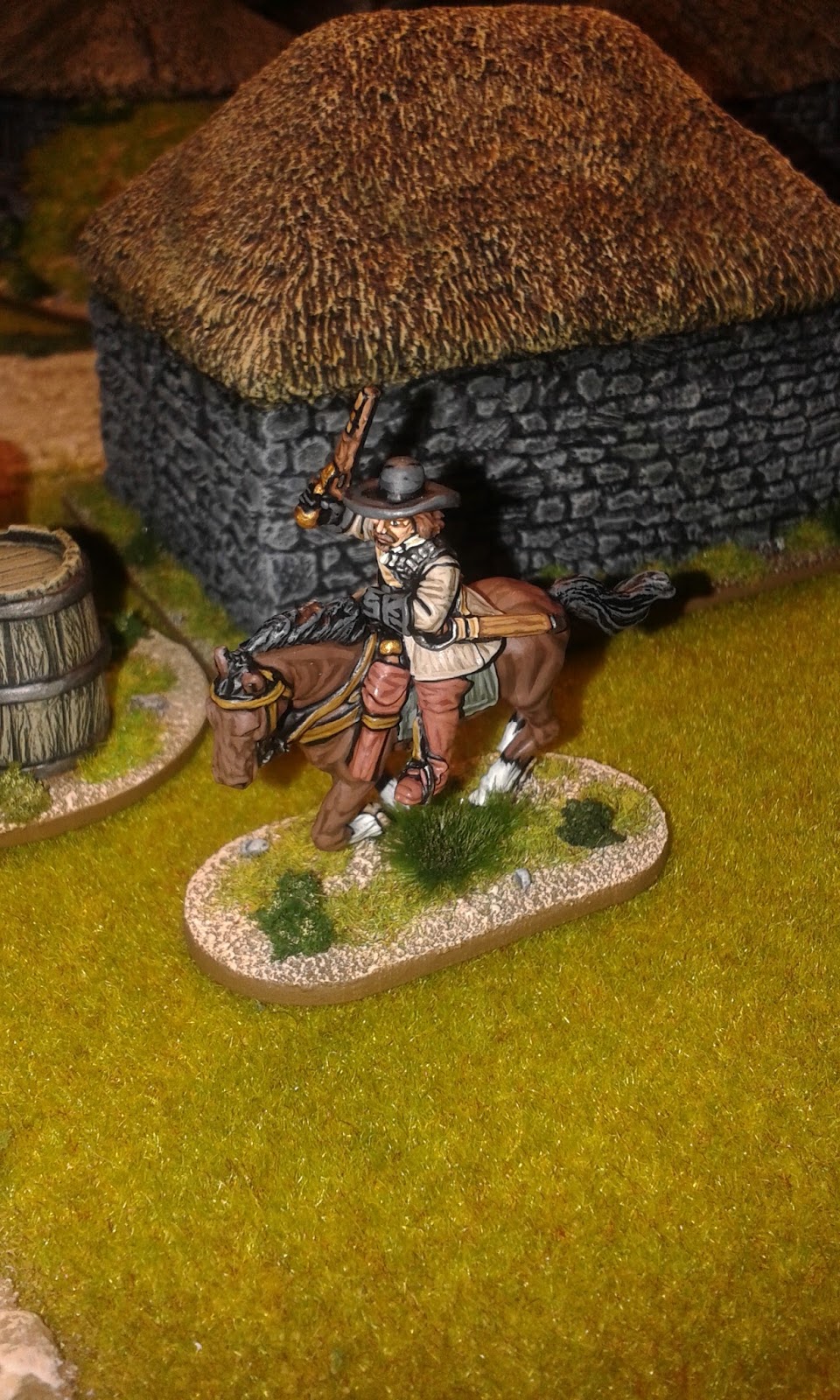
The Horse

A few words about the soldiers in this faction. They represent troops of the New Model Army, formed by The Committee of Both Kingdoms on 6th January 1645, and coming into practical existence around April of that year. It would appear that the term 'New Model Army' might only date from the 19th century, but judging by contemporary records from 1646, the term 'New Modelled Army' was in use, describing the way that existing regional forces had been used to form a centralised newly modelled or organised army. There are existing contracts for coats or 'cassacks' and breeches that date from August 1645 and February and March of 1646 (the old style calendar meant that these contracts were drawn up in 1645 - the new year in the Julian Calendar began in March), that show that certainly from this time onwards (ie late 1645 - early 1646), the new army was equipped in its famous red coats. However, as many of the soldiers from the three armies - Essex's, Waller's and Manchester's - that were used to create this new force were probably wearing red coats issued earlier, it's likely that by the time of the Naseby Campaign in 1645, many of the soldiers were already in red, even without the issue of the new uniforms.  Certainly by 1650 and Dunbar, this army would have been in the famous 'Venice red' that began the 'legend ' of the British Redcoat.
 
A Tawny orange 'montero' hat....a veteran of Essex's army, perhaps?...
 
Breeches were of 'grey or some other good Coloure'.  Regiments were distinguished by different coloured 'facings' or cuffs, and 'tapes' - the ties that held the coats together in place of buttons; 'ye tape to bee white, blew, greene, & yellow...orange'. I decided to paint mine yellow, as I can use these figures to represent another regiment with yellow facings from earlier in the Civil wars, though not all the figures from Perry Miniatures are sculpted with cuffs. Charles Fairfax's regiment had blue colours, and thus are likely to have had blue facings, but this is the only English regiment for the Dunbar campaign for which we have a sense of what colour facings or standards were shown. My figures could arguably come from for example, Colonel Alban Coxe's or Colonel William Daniel's Regiments.
 
'Blow off your loose powder'
 
Musketeers were equipped with bandoleers, with bottles or 'Boxes' '...to bee coloured blew with blew and white strings....'. I've chosen to paint a few of my shot with these blue bandoleers, to give a feel of the New Modelled Army. I did draw the line at blue and white strings for the bottles though! There aren't any contracts as far as I can tell, for armour for the Army, so my pike don't wear any, though doubtless some might have held onto helmets and possibly some back and breast.
 
'Order your pike...'
Pike were 'of good Ash sixteen foote long wth steele heads at three shillings Xd a pike...'. Interestingly, it would appear that by 1645, a ratio of 3:1 of shot to pike was more likely, instead of the more familiar 2:1, and this leads me on to the composition of my New Model Army Faction, in light of my recent reading.
 

The book on the right - 'Cromwell hath the honour but...: Major General Lambert's Campaigns in the North 1648' (P.R.Hill and J.M.Watkinson) is slightly off topic, but gives a good feeling for the character and experiences of one of the Parliamentarian commanders, John Lambert. Lambert was a major figure in the later years of the Civil wars, heavily involved in the defence of the north against the Scots and the Preston Campaign in 1648, and the Siege of Pontefract Castle;  as well as being one of the Army commanders in the Dunbar Campaign. He seems to have been a good leader, popular with his men, firm but fair, and generous in his terms with prisoners and the public. He was injured in a skirmish on 30th July 1650, as he led the rearguard of the retreating English Army, and his horse was shot in the neck and head, whilst Lambert was 'himself run through the arm with a lance...' and was captured, although quickly rescued later in the action. He seems to be an interesting character, and if I ever get deeper into this campaign and paint up a model of him, I'll write a fuller post about his life and career. I picked up this book at the Partizan show in spring of 2015.

Last week, the other book (on the left) - 'Dunbar 1650: Cromwell's most famous victory', by Stuart Reid, dropped through the letter box. It's one of the Osprey 'Campaign' series (No.142), and has given me food for thought about my Faction composition. Judging by the performance throughout the campaign, it seems as though I'm (just about) justified in giving my New Model Horse their 'Elite' status, although this is based purely on the numbers of veterans and battlefield performance. If I was running a campaign, they'd probably be merely Regular or 'trained', as the Scots often got the better of them, especially the Covenanter lancers.


The same would go for the foot - certainly by the time of the battle, the infantry were in dire straits, having lost many men (Reid suggests as many as 4-5000!) to sickness and malnutrition, caused by atrocious weather and a shortage of supplies. Having crossed the Anglo-Scots border on 22nd July, the English Army had to wait until mid August to have any tents! Only 3 out of the 8 regiments of infantry came directly from the 're-modelling', and one - William Daniel's - had only been recruited earlier in the year, intended for service in Ireland!  So a 'trained' status for the infantry might reflect the impact of the arduous conditions and experience, in a more realistic way. In terms of how this impacts on my faction, for the future, I may consider having 16 regular shot - worth 2 points, a unit of 4 elite pike (1 point), 6 elite cavalry (2 points), and a regular unit of 6 Dragoons (1 point). It would appear that 2 companies of Okey's Dragoon regiment were equipped as regular horse, but 4 companies acted in the 'usual style' mounted infantry role during the campaign. For now though, expansion plans are to add another 3 elite cavalry, and another 4 elite musketeers. This gives me a 6 point force, with 6 cavalry, 4 pike and 12 shot - more realistically reflecting the 3:1 ratio of musket to pike, and reflecting overall battlefield performance of the New Model army from 1645-1651. On that note - I'm going to keep my cards saying 'New Model Army'. Anachronistic, it maybe, but people feel familiar with it!

That is for the future though, so the next few posts will be about buildings, and livestock - including chickens and sheep! Then it's the turn of the Scots.....See you soon.
The Scots are coming.....

Baaaaaa!


Thursday, 22 October 2015

Donnybrook New Model Army Faction - The Horse!

Following hot on the heels of the foot for my Donnybrook New Model Army Faction, come the horse. These figures are all classed as Elite troops, and therefore 1 point gets you 3 figures. These guys are equipped with pistols, long swords and carbines, and wear armour. As Elite troops, they use a d10 to resolve firing and combat.

The Horse, with Activation card and Shaken marker....and random barrels!

The choice of Captain Hynde as a name was purely random - with all my 'unit' and character names, I've just gone with what sounds good. I wanted these units to be fictional and flexible, so I can use them for any actions of the NMA between 1645 and 1660. (I have, however, prepared a pack of Donnybrook cards for use in a different ECW action that are very much based on fact, but that will be a project for the future.) The figures are all Perry Miniatures, from packs ECW22 and ECW23.They've got a slight angle on the castings, but I can't work out if this is due to them getting bent slightly, or being sculpted like this, appearing to be 'on the move'.....I quite like the latter idea, and it certainly adds an air of motion to the figures. The shaken marker is from ECW12, and more about this chap (and others) can be found here:

http://haveacare.blogspot.co.uk/2015_01_01_archive.html#9029017225886469322

A close-up of the unit Shaken marker.

The figures were painted up using my usual mix of Wargames Foundry and Games Workshop paints, working from a black undercoat. I used WF Buff Leather 7 on two of the cavalry, and Rawhide 11 on the other. This added a bit of variety to the unit, and it's clear from pictures of Buff coats of the period, that there's lots of difference in shades. I also used Deep Brown Leather 45 quite copiously for boots and equipment. I have to admit that this colour is becoming one of my favourite Foundry colours - there's just enough of a variety in the shade, main and highlight tones to give a nicely balanced and realistic feel. The horses were painted using the Bay Brown 42 and Charcoal Black 34 shades. I was slightly apprehensive about painting these chaps, as horses always seem to be daunting, but in the end, it wasn't too bad. I guess that this is another advantage of skirmish rules, as you don't need too many figures.... as long as you don't want to game with a Mongol horde army! I'm still not convinced about my ability to paint black confidently, but I'll keep persevering and trying new shades or methods.

Once the horse were completed, this meant that my basic 4 point faction for Donnybrook was complete. In a future post, I'll detail ways that I'm going to expand on this, but for now this will do. These chaps have had a mixed bag so far in games - they do fairly well most of the time, but at Partizan they swept round a cart in a dramatic fashion to take on some Scots musketeers, only to meet a sticky end! They did look good though!  These figures were painted between March and September 2015.

Here come the Ironsides...

Thank you for all the positive feedback, both here and on other forums - it's good motivation to finish off this project, and to share more pictures and ideas. In the future, I'll add some more information about the historical background of my forces and the Dunbar campaign. To close, here's some more pics of the figures, both on their own and in action. Next up will be some scenery and 'fluff', then I'll move on to the Scots! See you soon.


Have they been seen off?...


No! Flee for ye lives!...

Cromwell's men on the rampage!...bye-bye to the vegetable garden! 

Tuesday, 20 October 2015

My 4 point New Model Army Donnybrook faction - the foot completed!

When I envisaged this Donnybrook project, I planned to create two basic factions, weighing in at 4 points each. This is a good place to begin, and gives a nice-sized force on the table - in fact, this is the recommended 'starting' point that the authors suggest in the rules.

Somewhere in Scotland, 1650...

Focusing on the English Civil War meant that I had a great amount of scope, in terms of armies and forces that could be represented on the table-top. So when I planned to paint up factions for the Dunbar campaign, it seemed only natural that the New Model Army of 1650 could be represented by the 'Elite' category of troops described in the rules. This gave me the following Faction:

1 Hero                                            (Free)
4 Elite Musketeers                         (1 point)
4 Elite Pikemen                              (1 point)
3 Elite Cavalry                               (1 point)

This meant that I had 16 figures in total to paint up, including 3 cavalry. Not a massive undertaking to start with. Throw in some 'shaken' markers, and it was still less than 20 figures! Even with my glacial rate of painting, I might be able to get this faction onto the table in a decent timeframe!

The NMA swing into action...

So, how did it pan out in reality? Well, in play-testing, we found that the individual companies were fairly brittle. Troops die easily in Donnybrook, whether they are 'Raw' troops or 'Elite'. With units testing for morale at 50%, losing just two figures as casualties would mean that a 4 man 'unit' could be out of action. The rules allow you to combine points together to make units of between 3 and twelve figures, so I decided to put together 2 points worth of Elite musketeers, into one unit of 8 figures. I've stuck with my 4 figure elite pikemen. This does mean that my infantry aren't that flexible in terms of tactics, only having one 'offensive' unit of shot, and a 'defensive' small unit of pike (depending how you use them, of course!), but the shot will last a bit longer, and won't have to test for morale quite so soon. I've got plans in the future to expand my factions to 6 points, which I'll detail in another post, so that might help with the flexibility issue. 

Here, then are the Foot of my New Model Army 4 point Faction, presented in all their glory, in action, and on parade. Painted between February 2014 and May 2015
Next up, the horse!...

The completed foot, with Activation cards and Shaken markers

The foot from the front...


...and from the rear


The pike ready to cover the musket whilst they reload...

'Present your pieces!....'


Saturday, 17 October 2015

Major Hawkins' Company

Blimey! Long time, no post! Apologies for that, regular followers and casual droppers by........hopefully this will change over the coming months.

However, progress has been continuing here at Pell Mell Towers, with lots going on since January (the last time I posted!). Over the coming few weeks, I'll update people with progress on my Donnybrook ECW project, which has been ticking along nicely. First up is the progress and completion of Major Hawkins' company of Musketeers. I first wrote about these chaps last October http://haveacare.blogspot.co.uk/2014_10_01_archive.html#6929832098667080127, but they've now been finished off.


The completed company, with activation card, Reload and Shaken markers


Here is the completed company of 8 figures - worth 2 points in a Donnybrook faction. In the rules, elite infantry can be 'bought' in groups of 4 figures - worth 1 point - and if required you can then combine troops into units of between 3 and 12 figures. After a few play tests, I decided to join together a pair of elite units, to form a bigger company. This means that my faction isn't quite as tactically flexible, having only one unit of musketeers, but it does mean that the musketeers stick around longer, and pack quite a punch, rolling 8 d10s!


The company in open order

These figures are all Perry Miniatures, from packs ECW8, ECW9 and ECW10. They were painted in my usual manner, working from a black undercoat and using Wargames Foundry paints. I've tried to add a sense of uniformity, with most of the troops having Slate Grey 32 breeches, and Granite 31 hose. I then paint some of the figures - normally one in four - with different colour breeches or hose. The same principle is carried out with the equipment using standard leather-like and 'natural' colours. So for instance, I'll paint three figures with Buff 7 baldrics, then the fourth has a different colour such as Conker Brown 54. This gives units a standardised, well-equipped feel, but with a natural variation. It also means that figures can be painted up quicker as well - always useful!

The company in action!

Next up will be shots of the complete company on parade and in action, so here's just a teaser of how they look together....

Captain Morris' pike and Major Hawkins' shot drawn up in classic ECW style,
 with Hawkins himself front and centre.

Until next time! See you soon.
 

Tuesday, 21 October 2014

Donnybrook Diaries - the advance of the shot!

Hello again! Well after last week's post about my terrain, I've been working away on my New Model Army musketeers for my Donnybrook English Civil War project. I had one figure completed a few months ago, as a test figure, but had to get the rest finished. These chaps are worth 1 point, and are classed as Elite infantry. They will be fielded as Major Hawkins' company, and here they are with their activation card. Elite infantry in Donnybrook can be bought in groups of four figures, but they can be combined with other elite infantry, to make a unit up to 12 figures strong. So these chaps will be combined with another point's worth of elite musketeers, to make a unit eight figures strong, which will be less tactically flexible on the table, but will at least stick around longer. They are all Perry Miniatures, based on 25mm Warbases circular bases.

I decided to paint these chaps with a variety of headgear - the black 'beaver' felt hat so beloved of ECW gamers was not as ubiquitous as the Victorians would have us believe, and a broad range of headwear was available to people of the 17th Century - the Perry twins have recognised this, so along with beaver hats, there are also Montero hats - the peaked cloth hat, often worn by members of the Oxford Army, but also sported by generals including Prince Rupert and Fairfax amongst others; knitted peakless Monmouth hats,
and 'Pound' hats - knitted headwear with a brim.
My musketeers and pikemen have a range of these.
Here we see the pikemen drawn up in normal order,
with a sleeve of shot next to it. The following photos show them in action, advancing over a bridge somewhere in Scotland. The next lot of musketeers are on the painting blocks, and are underway, so see you again soon! Apologies for the random layout again, I'm still struggling with Blogger, so if anyone can point me towards any decent tutorials, or offer any tips - is it better to add text before or after pictures, that kind of thing!