Showing posts with label Wargames 'fluff'. Show all posts

Saturday, 16 April 2016

The countdown to Partizan begins!

I've not posted anything on here for a few weeks - since February in fact - but that's not to say I haven't been busy!

With only five weeks to go before Partizan weekend, on Sunday 22nd May, it's all systems go for painting and production of figures and scenery. The RAW Gamers are putting on an enhanced version of the 'Somewhere in Scotland, 1650' skirmish game we put on last September, and I'm working away to get units and scenic bits and bobs completed in time. We'll be using the Donnybrook rules again, with added characters and expanded forces to those we used last time.

So, to wet your appetites, and to give a brief snapshot of what I've been up to since February and the previous post, here's a few pictures. I find that blogging takes up valuable painting time in the evenings, so will keep posts to a minimum over the next few weeks, until I've finished, but I just wanted to keep people updated. I'll do a more in-depth post on each unit or item after Partizan, but until then, here goes!:

First up, some camp items - the troops need feeding after all. These were picked up at one of the Derby Shows over the last two years, from Irregular Miniatures. They are listed in the 'siege equipment' section on their website.


Next, a hastily dug grave. I had some Greenstuff left over from basing trees, so smoothed it into a pile on a Warbases pill-shaped base, and then added a cross made out of balsa strip and superglue. Just right for setting a more sombre atmosphere - it could have been bullet, blade or plague that did for the poor unfortunate victim, and is a definite 'multi-period' item!


The vegetable gardens were inspired by an article on the Too Fat Lardies blog, and judging by the searches online, it seems as though I wasn't the only one who liked them! The 'flowers' used to make the cabbages were picked up from a shop on the high street, in the materials and craft section, and painted up. Rather convincing, I reckon; though possibly overly large for 28mm scale.....must be good natural fertiliser! They made their first appearance at the last Partizan game, but haven't appeared on here before. I want to add some fences at some point, to keep nibbling vermin out.


I've always liked The Last Valley's stuff - their scenic items always seem to appear on gaming tables around the conventions, and in many wargames rules and publications. They're good value, and well made too. I bought a couple of their trees at the Derby show last year, and rebased them in my style - a bit pedantic possibly, but now they 'fit' in with the other trees I've made. The flock on the trees was sealed using a non-perfumed hairspray (a railway modeller's tip!), and so far, it seems to be working!


A while ago, I started making my own trees, out of twisted wire frames. These were then based up using a hot-glue gun, and covered in air-drying clay. This was sealed with PVA and painted, then they were based up, sculpting the roots with Greenstuff before adding my usual sand and PVA mix. When everything was dried and painted up, I added some Woodland Scenics foliage. Perfect for small 'gnarly' trees, that wouldn't look out of place in most wargames 'theatres' of conflict, from Scotland to Spain! I'm quite proud of these, as they're totally scratch-built.


Having completed a unit of dragoons for my Scots faction for the Donnybrook ECW project, which gave me my first faction 'point', it's time to show my next unit, the pike. These chaps have made a few appearances on the blog in recent months, but not in full force. A small unit of 4 figures was on the table at the Other Partizan last September, but now I've finished them all off. It was the figures in plaids that were awaiting completion! (Have I ever said I dislike painting tartan or checked patterns?....) These 8 figures give me a full unit of 'regular' pike, worth another 'point'.


A few close ups:


All these pike-wielding chaps are Perry Miniatures. The same goes for my first Scots Musket unit, which gives me another point for the Scots faction.. Again, these 8 figures are classed as 'regular' in Donnybrook terms, and include the very first figures I had painted up for this project when I started it, back in 2014! For ages, I only had these two musketeers, then the dragoons made an appearance, and now finally, this first unit of musketeers has been completed!

Tam issues the order to fire!

Once again, it was the plaid-clad figures that slowed down the completion of this unit, but last Monday, I was able to get them done. The casualty marker in the background is a figure from the Wargames Foundry ECW casualty pack, which I hi-lighted in the last post.

Foundry also provided the figures shown in the last pictures, drawn from their ECW civilians packs.

Màiri keeps a close eye on her brother, as he staggers back from the well...
...Wee Willie, with his not so wee bucket! Mind it doesn't spill!
I really like these figures, and I have a few more civilians to paint up, to populate the settlements that are going to feature in our game.

There's 8 more Scots musketeers to paint, and 8 characters 4 civilians, then a few more bits of scenery - walls and suchlike, maybe some more trees, then I'm done. I'm not sure where we'll be yet at the new 'Partizan' venue, but I'll post before the show with more updates so people can pop by if they wish. After the show, I'll showcase more of the units and bits of scenery, in greater detail. Then it's on to a new project, which readers can follow on here over the summer. Thanks for the continued support, and see you soon! Five weeks to go!... back to the brushes....


Monday, 30 November 2015

Feeling Two Tents? Not any more!

Hello again - it's been a while since the last post, so apologies for that! Up until a few days ago, I hit a wall in terms of painting.....real life, rubbish weather here in the UK, and general tiredness have take their toll in the evenings, so the brushes were being neglected. However, I finished off the last of my sheep earlier this week, which seems to have shaken off some of the lethargy, and I'm ready to get cracking again. No longer tense.....

Multi-period real estate from Renedra
Speaking of tents...... as mentioned in the previous post, I thought I'd write a small piece about the canvas shelters that are going to grace the tabletop in my ECW project. These are two of the lovely plastic tents from the Renedra Limited 'Ridge tents' set, which I picked up at the Partizan show last spring. I've still got two more to paint up at some point, as well as the camp beds that come with the set, but these beds are possibly 'out of period' for the 17th century. The camp fire is the other part of the set, which I've mounted on a circular base from Warbases.

Photo from Yahoo

Shelters in one form or another have featured in military service for thousands of years. Even if the rank and file still slept in the open, then at least their leaders or commanders would have had some form of tent or headquarters, befitting their status. During the wars of the 17th Century, shelters would have taken many forms, as shown in this woodcut of the 30 Years War.

Photo from Yahoo
There are many different types of shelter here - ranging from simple canvas sheet 'tents' in the foreground, to more ornate tents in the background, and shelters made from either canvas or wooden panels or 'sheets' on the left hand side of the picture. I like the idea of making some wooden shelters or canvas sheet tents at some point in the future, but for now I'll stick to the Renedra ones, and possibly get some dog tents from them as well.

The back of one of my tents, pitched near water. A soggy night ahead?

 
I put both of my tents on uneven shaped bases from Warbases, to protect them from damage and chips to the paintwork. They were undercoated in Wargames Foundry Canvas 8A shade, then painted over in the 'body' of the tents using Canvas 8B, leaving the 'sewn' lines where panels meet, and shading in the A shade. Then they were given a substantial highlight with Boneyard 9 B shade, followed by a final highlight of Boneyard 9B +9C mix, along the lines of the creases, ridges, and 'edges' etc. Having spent countless days and nights in these sorts of tents over 20 years  of re-enacting, I was especially keen to keep them to a more 'realistic' shade of canvas, instead of the more usual white that often graces the war-gaming table. Although these types of tents will be bleached by the sun, they often maintain at least a semblance of the pale cream canvas colour. The word "canvas" comes from the 13th century Anglo-French canevaz and the Old French canevas. Both of these words are derived from the Vulgar Latin cannapaceus for "made of hemp". Sadly the pictures haven't given a true representation of how creamy-white the models are, but I'm sure you'll get an impression.

Don't forget the tent pole!
The picture above shows off the entrance and interior of one of the open tents. I used a mix of diluted PVA glue and offcuts from a doormat to represent straw laid down on the floor of the tent. The tent pole is made of a cocktail stick, painted up. This only came about after I showed my significant other the (I thought) completed tent. "There's something missing," she exclaimed, "... a tent pole!" Thanks, love! So one was hastily added, and the subsequent slight gap was covered up by a small amount of foliage. On Living history camps, there's an oft seen sight of fresh herbs hanging in front of tents - either to dry for cooking, to prevent bad smells, or to ward away evil plague-bearing 'miasmas'! A simple touch, yet one that adds a touch (or should that be whiff) of authenticity!

Another aspect of camp life is the stowage and general clutter. I have painted up some stowage piles from Ainsty Castings trade goods range. I've now got a range of items, such as chests, barrels, fleece 'bales', and goods in wicker baskets, to go around my tents and houses. These not only give a sense of life to the table, but also offer cover for my troops.


Lastly for this post, a few words on some small bits of terrain I made earlier in the year, to show where there is 'rough' ground. These were put together using 3mm thick ply, cut and sanded to various shapes, then they were glued together with PVA. Modelling clay was used to smooth out the slopes, then I covered them in my usual PVA covered with sand 'mix'. Once dry, they were painted up, and various types of Woodland Scenics foliage added. I think they've turned out nicely, and again add another dimension to the table top.

Rough ground out of roughly trimmed off cuts...
Below are a few pictures of the completed assembly, and some scenes of camp life. I've still forgotten to take a group shot of my buildings, so that will definitely be in the next post! As will the start of the Scots......until next time!

Time for drill
A prisoner meets an untimely end...

... and Tam McLeod plans revenge!


Tuesday, 10 November 2015

All creatures great and small.....

Now that my New Model Army (or Newly Modelled English Army, in light of my previous post!) Faction is complete - at least in it's 4 point basic stage, without any revisions - it's time to turn attention to the Scots, and the other parts of my Donnybrook ECW project. So first up, it's the turn of the creatures inhabiting the table alongside the soldiers.

Pikeman Dolittle talks to the animals...
 
Back in January, I wrote about 'fluff' on the battlefield table top - the bits of scenery and accessories that aren't necessary for game play, but look rather good and set the scene, adding atmosphere and context. In skirmish games, this type of scenery can take a role of greater importance, acting as cover or hindrance to individuals or small groups of figures. Sometimes though, 'fluff'  is purely aesthetic - after all, who really needs chickens?!!

Well, I reckon things like this - little cameo bases, livestock, small scenic items and so forth, really set the scene. I've always been inspired by gamers who put effort into such things, such as Sidney Roundwood and his objective markers, The Two Fat Lardies, and especially Simon Chick, with his Harness and Array and Je Lay Emprins blogs. Their efforts to 'set the scene' are sublime and often innovative, and an example to follow.  My Celtic Cross instantly sets the scene for the table, giving the onlooker the impression that we're somewhere in Scotland or the north of England, or Ireland. Highland cattle or the buildings again suggest Scotland or Northern Britain. So when it came to painting up livestock for my game, I wanted to be reasonably accurate about my animals - if somewhat anally retentive about the level of detail!

First up on the animal painting itinerary, appeared my Highland Cows, from Warbases. I finished these off a while ago, but still have a soft spot for them.


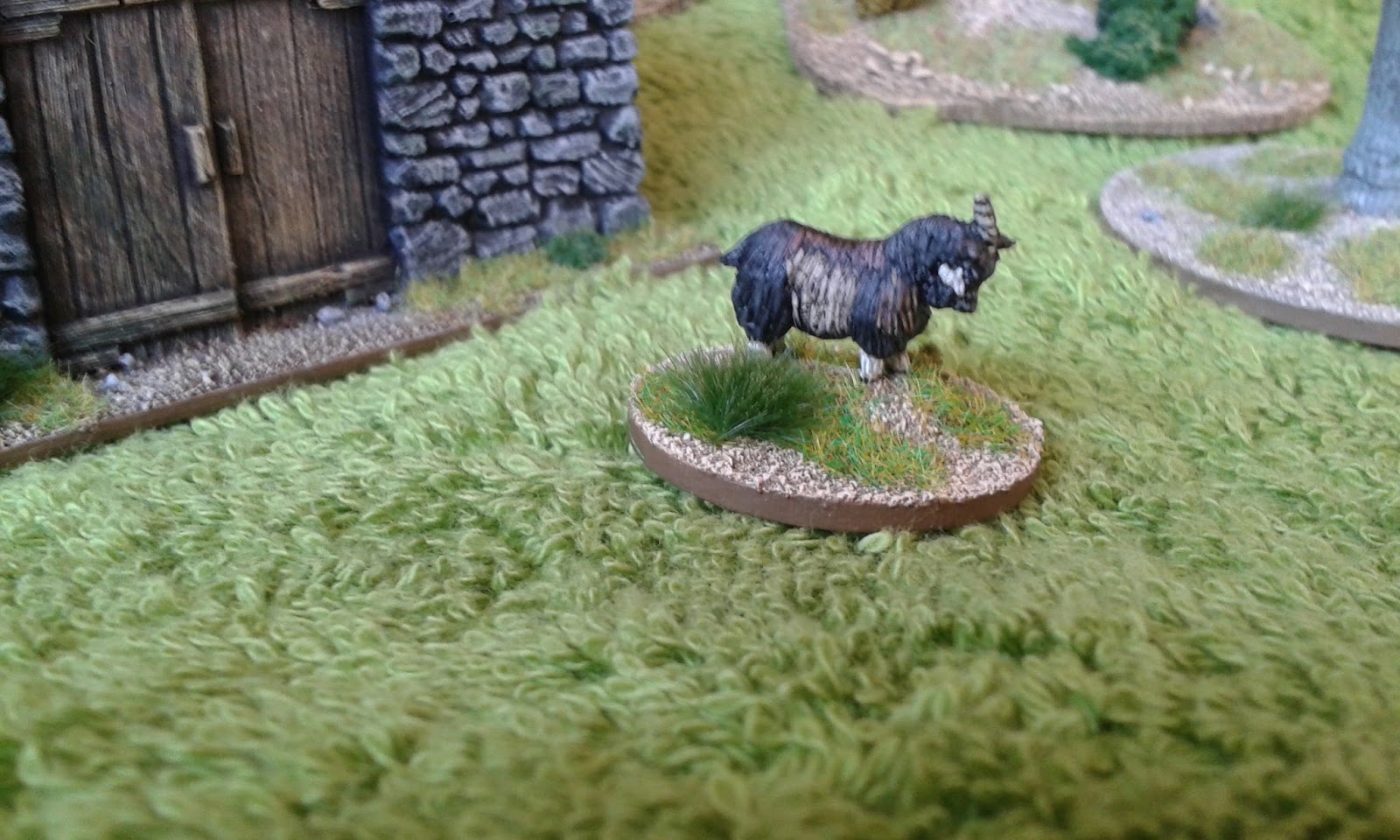
Next, came a goat, I think from Irregular Miniatures, picked up at the Derby World's show in 2014.


I decided to paint this particular example up as an example of the Cheviot goat - one of the types of British primitive goat that was introduced to this country around Neolithic times. I thought that this breed would do nicely for a 'multi - period' goat, suitable from at least Iron Ages times, right up until the 18th century at least.

Photo courtesy of Bing.


My chickens came from Warbases, and after a bit of internet research, I decided to paint these up as a type called the 'Scots Grey'. This is a breed that has been in existence for at least 200 years, and that originated in Scotland. I thought that this would be a good 'bog-standard' chicken to have scratching around my northern farmsteads, suitably drab, but fairly eye-catching with its speckled markings. They were a real pain to paint, with a black base coat, and two sets of grey highlights (yes, two!...) which seemed to take ages to 'dot' on, but I think they're worth the effort.

I didn't chicken out on the markings......

The original. Photo from Bing.

The most recent creatures to enter the 'Donnybrook Ark', are my sheep, from Hovels. I wasn't too sure how these would turn out, but I have to admit, I love them! I've got one more from the pack of six, still to paint, as well as two from Irregular sculpted in a slightly different style. I surpassed myself in the painting stakes with these sheep, putting in probably way too much effort on them, for what they are. I started off with a black undercoat, then dry brushed them with 11C Rawhide from Foundry, then another dry brush of 29C Moss. Next was a thin wash of 30C Raw linen, then when this was dry, another dry brush of Boneyard 9B, then one of Boneyard 9C to finish off. The eyes were dotted in using Spearshaft 13A. Ears were filled in using Boneyard 9A. The face, ears and legs were painted using a mix of i) Arctic Grey 33B and Boneyard 9B, then ii) White 33C and Boneyard 9B mix, and iii) a final high light of pure white. Phew! The horns on the ram were done with a range of browns, picking out the details of the grooving on the horns' growth.

Baaaaa!!!


Cheviot Sheep. Photo from Bing

 
I based these sheep on the Cheviot, a white-faced breed that has been used for wool in the border regions of Scotland and England for centuries. It has been recognised as a hardy breed, since at least 1372. The wool of this sheep was often used in the tweed industry, and the animal has a similar appearance to styles of 'white -faced' sheep that were introduced by the Romans, so I might be able to use these models as far back as the 1st century on Roman villas.


In need of a shepherd!
At some point, I'll get round to painting some civilians from Wargames Foundry, one of whom is a shepherd, so he'll do nicely for looking after these creatures. Apart from the three remaining sheep, I'm about there for my livestock. I've based them upon small bases (from Warbases), individually or in pairs, so that I can spread them out a bit. They might also be used as 'booty' in raid scenarios.

Apart from domesticated animals, I'm also thinking about 'wildlife' as well. I bought a pack of Red deer from Warbases   at Warlord Games Games day in 2014, and I've recently got hold of some of their rabbits as well.

What's up doc?....Bunnies for the pot!


Hopefully that has given people a few ideas about including animals in their games - at the least, they look really good, and they'll be a talking point! Next up will be a post on the buildings that are going to feature in this project. See you soon!